Hiring developers is difficult because resumes and interviews can tell you a lot about a candidate, but they do not always show how well that person can actually write and debug code.
A strong resume may show years of experience. An interview may show how clearly someone communicates. But when the role requires programming, hiring teams also need evidence of practical technical ability.
That is where coding assessments can help.
TestHike is a coding assessment platform designed to help organizations evaluate candidates through practical programming tasks in real development environments. Instead of relying only on what candidates say they can do, teams can review what they actually produce.
The approach follows a broader principle used in skills-based hiring: ask candidates to perform tasks that are similar to the work they will actually do. The U.S. Office of Personnel Management describes work-sample assessments as tasks that mirror real job activities and notes that these assessments can provide strong evidence of job-relevant ability.
Here are some of the main reasons teams choose TestHike.
Technical Hiring Needs More Than Resumes and Interviews
Resumes are useful for understanding a candidate's background, experience, education, and previous responsibilities.
Interviews are useful for discussing that experience and understanding communication, decision-making, and working style.
But neither method directly proves that someone can solve a programming problem.
For technical roles, hiring teams often need to answer questions such as:
Can this candidate write working code?
Can they understand a problem and turn it into a solution?
Can they handle edge cases?
Can they debug an incorrect solution?
Can they work within the programming language required for the role?
A practical coding assessment adds another piece of evidence to the hiring process.
This does not mean coding assessments should replace interviews or human judgment. Instead, they can give recruiters and engineering teams additional information before making a decision.
Evaluate Real Programming and Problem-Solving Skills
One of the main reasons teams use TestHike is to evaluate candidates through actual coding tasks rather than relying entirely on theoretical questions.
TestHike candidates complete assessments inside a desktop application with real programming environments rather than a limited browser-only interpreter. TestHike currently supports environments for languages including Python, JavaScript, TypeScript, Java, C++, C#, Go, Rust, Ruby, Kotlin, Swift, PHP, and others.
This allows hiring teams to create assessments around the capabilities they actually want to measure.
For example, instead of asking:
“How would you solve this problem?”
you can ask the candidate to solve it.
The final result gives the hiring team evidence based on the candidate's submitted work rather than only their explanation of what they might do.
Give Candidates a More Realistic Coding Experience
A coding assessment should feel reasonably connected to the skill being evaluated.
Research on work-sample assessments emphasizes this same idea: assessments are most useful when the tasks resemble important activities performed in the actual job.
With TestHike, candidates work in a dedicated coding environment where they can write, run, test, and submit code.
This helps move the assessment closer to practical development work instead of turning programming evaluation into a multiple-choice exercise.
It can also make the purpose of the assessment clearer to candidates: demonstrate your ability by solving the problem.
Measure More Than Whether Someone Memorized an Answer
Programming work involves more than remembering syntax.
Developers regularly need to:
understand requirements;
break problems into smaller steps;
choose an appropriate approach;
write working code;
handle unexpected inputs;
test their solution;
identify mistakes;
improve their implementation.
Well-designed coding tasks can provide useful evidence across several of these areas.
The goal should not be to make an assessment unnecessarily difficult. It should be to create a relevant task that helps the hiring team understand whether a candidate has the skills required for the role.
Make Evaluation Faster With Automated Grading
Manually reviewing every coding submission can become difficult when an organization is evaluating dozens or hundreds of candidates.
It also consumes engineering time.
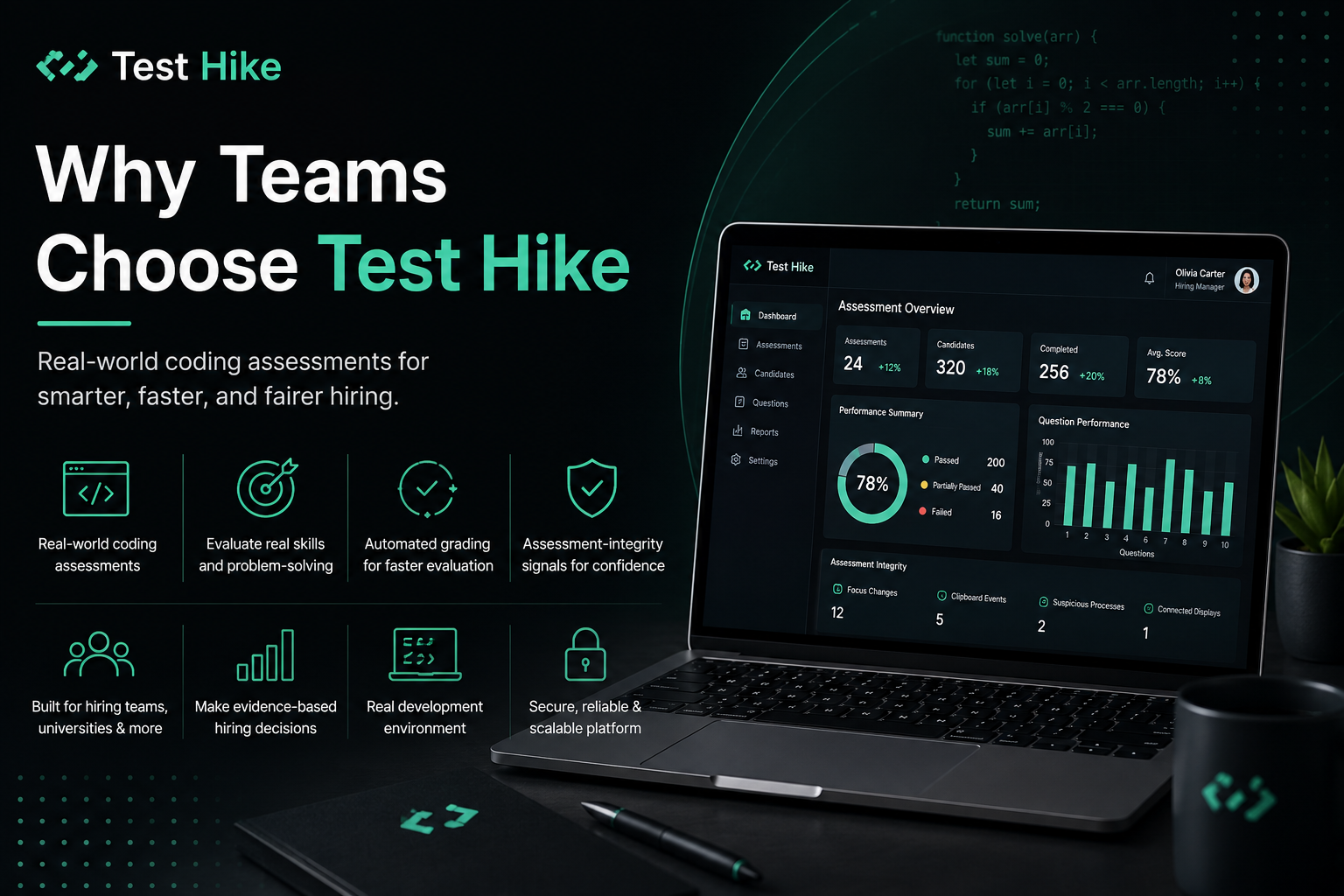
TestHike uses automated test cases to grade coding questions. A candidate's coding score is based on the proportion of configured test cases their submission passes, combined with the weight assigned to that question. Results are then made available to the hiring team through the assessment dashboard.
This allows teams to quickly identify:
which tests passed;
which tests failed;
the candidate's score;
performance by question;
the submitted solution;
relevant assessment activity.
Recruiters can therefore use structured results during the initial screening process without requiring a senior engineer to manually execute every candidate's code.
Engineering teams can still review submissions in more detail when necessary.
Apply Consistent Evaluation Across Candidates
Consistency matters when several candidates are being considered for the same position.
If Candidate A is evaluated by one engineer and Candidate B by another, purely manual evaluation can introduce differences in how each submission is interpreted.
Automated test cases provide a common baseline.
The same question can be evaluated against the same expected outcomes for every candidate.
That does not eliminate the need for human judgment. Code quality, architecture, communication, maintainability, and other factors may still require human review depending on the role.
But automated grading can make the objective parts of the assessment more consistent.
Standardized reviewing and scoring procedures are also an important principle when assessments are used in hiring decisions.
Build More Confidence With Assessment-Integrity Signals
A high score is useful, but hiring teams may also want context around how the assessment was completed.
This has become particularly important as candidates have access to more external tools, AI assistants, secondary devices, and other ways of receiving help during an assessment.
TestHike runs through a desktop application rather than only inside a normal browser tab. Depending on the assessment configuration, the platform can record signals such as:
focus changes;
clipboard activity;
connected displays;
relevant running processes;
device and submission integrity information.
TestHike presents these as assessment-integrity signals, not automatic accusations of cheating. The hiring team reviews the information and decides whether anything requires further investigation.
That distinction matters.
One unusual event should not automatically determine a candidate's outcome. Integrity information works best when it provides context that a reviewer can consider alongside the candidate's code, score, and overall assessment.
Reduce Subjective Decisions in Technical Screening
Technical hiring will always involve some human judgment.
The goal is not to remove people from the decision.
The goal is to make sure decisions are supported by useful evidence.
Consider two candidates:
Candidate A has a strong resume and performs well in conversation.
Candidate B has a less impressive resume but performs significantly better on a relevant coding task.
Without a skills assessment, Candidate B may never get the opportunity to demonstrate that ability.
A structured technical assessment gives hiring teams another signal to consider.
Rather than making an early decision based primarily on where someone previously worked, what university they attended, or how confidently they speak during an interview, teams can also look at demonstrated skills.
This is part of the broader shift toward skills-first hiring, where organizations evaluate what candidates can do rather than relying only on credentials or previous job titles.
Support Better, Evidence-Based Hiring Decisions
No single hiring signal provides a complete picture of a candidate.
A good hiring process can combine several sources of information:
relevant experience;
structured interviews;
practical assessments;
technical discussions;
portfolio or previous work;
references where appropriate.
Coding assessments strengthen this process by adding direct evidence of technical performance.
For example, a hiring team may see that a candidate:
passed 90% of the automated test cases;
solved the main problem correctly;
struggled with one edge case;
completed the assessment within the expected time;
showed no assessment-integrity activity requiring review.
An engineering manager now has something specific to discuss in the next interview.
Instead of asking another generic algorithm question, they might ask:
“Your solution handled the normal cases well, but this edge case failed. How would you change your approach?”
The assessment becomes an input into a better technical conversation rather than simply a pass-or-fail gate.
Create a Better Experience for Candidates
Assessment security and candidate experience do not have to work against each other.
Candidates should understand:
what they are being assessed on;
how long the assessment will take;
what tools they can use;
what activity is monitored;
how their work will be evaluated.
TestHike's candidate flow uses an invite code that opens the assigned assessment in the desktop application. Candidates can write and test their solution within the configured environment before submitting it.
TestHike also supports local progress saving during temporary connectivity problems. According to the platform documentation, assessments can continue through a connection drop and synchronize information when connectivity returns.
This is particularly useful for remote assessments, where a temporary internet problem should not necessarily destroy a candidate's work.
Manage Technical Assessments at Scale
Running one technical assessment is relatively easy.
Running hundreds consistently is much harder.
As candidate volume increases, teams have to manage:
assessment creation;
question selection;
candidate invitations;
deadlines;
grading;
results;
integrity review;
different job roles;
repeated assessment campaigns.
TestHike brings these activities into one assessment workflow.
Hiring teams can create assessments using existing questions or custom tasks, assign weights, send candidate invitations, and review incoming results through the dashboard.
Automated grading then reduces the amount of repetitive manual work required for each additional candidate.
This makes the platform useful not only for individual hires but also for organizations running larger technical screening programs.
Hiring Teams
Recruiters can use structured coding results as another screening signal before moving candidates into expensive technical interview stages.
Engineering Managers
Engineering managers can create assessments that better reflect the skills their teams actually require and spend detailed review time on the candidates who progress.
Universities
Universities can use coding assessments for programming exams, labs, or practical evaluations where student code needs to be tested consistently.
Training Organizations and Bootcamps
Training teams can assess whether learners can apply what they have studied rather than relying only on course completion or attendance.
Why Teams Choose TestHike
TestHike is designed around a straightforward idea:
If programming ability matters for the decision, candidates should have an opportunity to demonstrate programming ability.
Teams choose TestHike because it combines several parts of technical assessment in one platform:
practical coding tasks;
real programming environments;
automated grading;
standardized scoring;
assessment-integrity signals;
candidate activity information;
customizable questions;
centralized results;
support for Windows, macOS, and Linux;
support for multiple programming languages.
The result is not a replacement for recruiters, interviews, or engineering judgment.
It is a way to give those people better evidence.
Instead of asking hiring teams to make a technical decision based primarily on a resume or a conversation, TestHike helps them include actual coding performance in the process.
Frequently Asked Questions
Why should companies use coding assessments when hiring developers?
Coding assessments give employers direct evidence of a candidate's programming ability. They can complement resumes and interviews by showing how someone performs on a relevant technical task.
How does TestHike evaluate a candidate's programming skills?
Candidates complete coding questions in the TestHike desktop environment. Their submissions can be evaluated against automated test cases, producing structured scores and per-question results for the hiring team.
How does TestHike make technical assessments more realistic?
TestHike uses a desktop coding workspace with real programming environments rather than limiting candidates to a simple browser-based interpreter. Teams can also create custom coding tasks that reflect the technologies and skills relevant to their roles.
Can TestHike help reduce subjective evaluation in technical hiring?
TestHike provides standardized assessment questions, automated test cases, weighted scoring, and structured results. These provide consistent technical evidence that hiring teams can use alongside interviews and other evaluation methods.
How does TestHike help maintain assessment integrity?
TestHike can provide reviewable signals such as focus changes, clipboard activity, connected displays, and selected process activity during configured assessments. These signals provide additional context to reviewers rather than automatically determining that a candidate has cheated.
Can TestHike be used outside traditional hiring?
Yes. TestHike is designed for technical hiring as well as programming assessments used by universities, bootcamps, training organizations, and engineering teams.
Make Technical Decisions With Better Evidence
The purpose of a coding assessment should not be to add another unnecessary step to hiring.
It should help answer an important question:
Can this person demonstrate the technical skills required for the opportunity?
TestHike gives teams a practical way to collect that evidence, evaluate it consistently, and use it alongside the rest of their hiring process.
See how TestHike helps teams run practical, secure, and scalable coding assessments.